
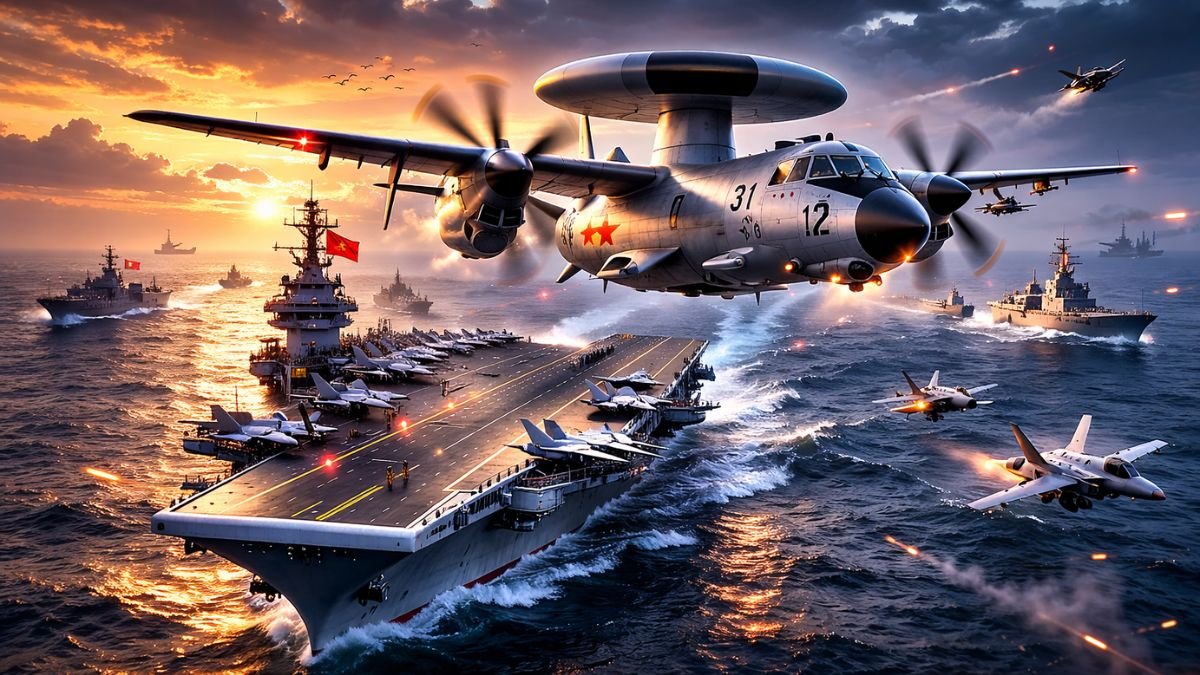
In recent years, global military landscapes have been transformed by rapid technological developments, with China emerging as one of the strongest forces reshaping the balance of power. Among its most talked-about innovations is a prototype aircraft that has caught the attention—and concern—of the United States. Known as the KJ-600, this carrier-borne early warning and control aircraft signals more than just a technological milestone. It represents China’s bold attempt to challenge America’s long-standing dominance in airborne surveillance and combat management.
What Makes the KJ-600 So Significant
The KJ-600 is not just another aircraft being tested by China. It marks the first time the nation has produced an advanced carrier-based Airborne Early Warning and Control (AEW&C) platform comparable in concept to the American E-2D Hawkeye. This type of aircraft is crucial because it acts as the “eyes and brain” of a fleet, detecting threats long before they reach the carrier group and directing fighters with real-time battlefield intelligence.
The United States has relied on such systems for decades to maintain wide-ranging aerial supremacy. The introduction of the KJ-600 means China is rapidly closing the technological gap that once separated it from Washington’s capabilities. For American defense strategists, that shift introduces new complexity into an already tense Indo-Pacific environment.
Expanding China’s Power at Sea
One of the core reasons the U.S. views the KJ-600 with concern is its direct connection to China’s growing aircraft carrier program. Earlier carriers like the Liaoning and Shandong lacked the sophisticated catapult launch systems required for fixed-wing early warning aircraft. With the launch of the Fujian—China’s first carrier equipped with electromagnetic catapults—the KJ-600 now has a platform to operate effectively.
This gives China, for the first time, a near-complete carrier strike capability similar to that of the U.S. Navy. A carrier group with long-range fighters, early warning aircraft and advanced radar can project power across vast sections of the Pacific. The KJ-600 strengthens China’s maritime presence, allowing it to oversee larger operational zones, track adversary aircraft earlier and coordinate complex missions with far greater efficiency.
A Threat to America’s Air Supremacy Strategy
For decades, U.S. military power in the Asia-Pacific has depended heavily on its ability to see, detect and respond faster than any potential adversary. Airborne early warning aircraft have played a decisive role in that strategy. The emergence of the KJ-600 shows that China is building the same pillars of aerial dominance, and that shift alters the calculations Washington must make.
The KJ-600’s advanced radar system, believed to incorporate Active Electronically Scanned Array (AESA) technology, increases China’s reach over contested zones such as the South China Sea or the Taiwan Strait. This raises the possibility that U.S. aircraft could be detected earlier, targeted faster and challenged in areas where they once operated with overwhelming superiority.
Implications for Future Conflicts
The development of the KJ-600 does not suggest that China has surpassed the United States, but it represents a significant milestone that narrows the gap. If a future conflict were to erupt in the Indo-Pacific, both nations would rely heavily on early warning aircraft to guide their operations. The presence of the KJ-600 introduces new layers of uncertainty and could shift the balance of power in contested areas.
For regional neighbors, this development is a reminder that strategic competition between the world’s two largest powers is intensifying. As China strengthens its navy and enhances its aerial intelligence network, smaller nations may find themselves caught between two giants seeking influence and control.
A Symbol of China’s Larger Ambition
Beyond its technical features, the KJ-600 symbolizes China’s ambition to build a military force capable of rivaling the United States on a global scale. It shows that China is no longer content with regional influence but is preparing for a future where it expects parity with Washington. This sentiment, perhaps more than the aircraft itself, is what makes American defense planners cautious.
Conclusion
The rise of the KJ-600 marks a turning point in modern military aviation. It reflects China’s determination to break through the technological ceiling that once separated it from the United States. For Washington, this prototype is more than a new aircraft—it is a reminder that its air supremacy, long taken for granted, is now being challenged by a rival rapidly gaining strength. The coming years will reveal how this growing competition shapes global security, but one thing is clear: the KJ-600 has already changed the conversation about power in the skies.