
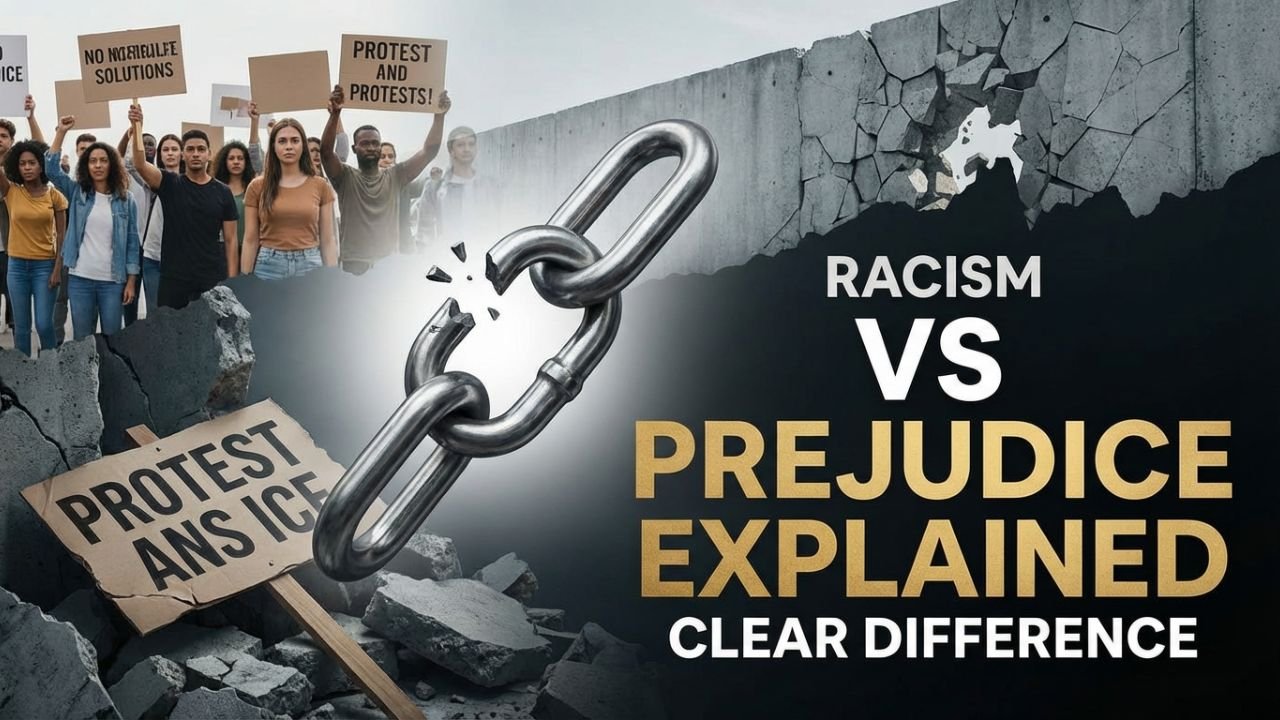
Often, we use the terms prejudice and racism interchangeably in everyday conversation, but from a social science perspective, these are two distinct concepts. Both are related to discrimination and injustice, yet their effects, scope, and consequences are not the same. Understanding this difference is crucial because only then can we get to the root of inequalities in society and take concrete steps to eliminate them.
Prejudice is primarily an opinion formed about an individual or group without complete information, while racism is not limited to just thoughts or feelings, but affects the entire society through power, institutions, and policies. Simply put, every instance of racism involves prejudice, but not every instance of prejudice is racism.
What is Prejudice?
Prejudice means a preconceived notion about a person or group that is not based on experience or concrete information. This notion can be negative and sometimes even positive, but in both cases, it does not fully reflect reality. According to sociology, prejudice is a kind of “prejudgment” that people make about others without truly knowing them.
For example, the belief that “people with blonde hair are not intelligent” is a type of prejudice. Such jokes or comments may seem harmless, but they also confine a group to a limited and inaccurate identity. However, such prejudices usually do not determine major life opportunities for an individual.
Is Every Prejudice Dangerous?
It is important to understand that not all prejudices are equally harmful. Some prejudices remain limited to the individual level, such as jokes, comments, or private behavior. These can be emotionally hurtful, but they often don’t change the social structure or institutional systems.
For example, if someone is teased because of their hair color or accent, it can be psychologically distressing. But this doesn’t determine their chances of getting into college, finding a job, buying a house, or being stopped by the police. Therefore, there’s a significant difference between such prejudices and the effects of systemic racism.
What is Racism and How Does it Work?
Racism is not simply limited to the thoughts of an individual; it is deeply intertwined with power and systems. According to sociologists, racism is the process through which power and resources are unequally distributed based on race. This includes laws, policies, institutions, and cultural beliefs that establish one race as superior and another as inferior.
Examples of racism are clearly visible throughout history, such as racial segregation laws, where public places had signs designating areas “for whites only” and “for others.” These were not merely symbols of individual hatred, but part of an entire system that granted certain privileges to some and limited opportunities for others.
Racial Slurs: Not Just Words, But Part of a System
Racial slurs or derogatory terms are not simply expressions of individual prejudice; they evoke centuries of inequality and oppression. Such words have been used throughout history to justify slavery, exploitation, and discrimination. Therefore, when these words are used today, they perpetuate and reinforce the same unequal system.
This is why racial slurs cannot be dismissed as merely “wrong thinking.” These words are connected to social structures that continuously disadvantage certain communities in terms of education, employment, safety, and respect. —
The Consequences of Systemic Racism
The most serious form of racism emerges when it becomes institutionalized. This means that discrimination is not limited to individual behavior but extends to laws, policing, the education system, employment, and the media. As a result, certain racial groups repeatedly face unequal treatment.
This manifests in ways such as people from certain communities being stopped more frequently by the police, being more likely to be arrested and imprisoned, facing discrimination when applying for jobs, or experiencing less development and investment in their neighborhoods. These examples demonstrate that racism is not merely an attitude but a social problem that affects every aspect of life.
The Fundamental Difference Between Prejudice and Racism
The biggest difference between prejudice and racism lies in power and influence. Prejudice can be directed towards any individual or group, regardless of their power in society. However, racism is only possible when a group possesses social, political, or economic power that allows them to systematically disadvantage other groups.
Therefore, it is incorrect to say that everyone experiences racism in the same way. Groups that already hold privileged positions in society may experience prejudice, but their experience will be different from those who face institutionalized discrimination based on their race.They have to face discrimination.
Conclusion: Understanding is the beginning of change
If we want to create a just and equitable society, we must seriously understand the difference between prejudice and racism. It’s not enough to simply change individual attitudes; we must also question the systems and policies that perpetuate inequality.
Only when we acknowledge that racism is a systemic problem and that prejudice is one of its roots can we move towards effective solutions. Through awareness, education, and self-reflection, we can lay the foundation for a society where every individual is respected not on the basis of their race or identity, but on the basis of their humanity.
