
Equality and equity are two terms that are often used interchangeably in everyday conversation, but they carry very different meanings, especially when discussing fairness, opportunity, and social justice. Equality refers to giving everyone the same resources or treatment, regardless of their circumstances. It assumes that everyone starts from the same place and has the same needs, which is rarely the case in reality.
Equity, on the other hand, acknowledges that people start from different positions and face different challenges. It focuses on fairness by providing resources and opportunities based on individual needs. While equality aims for uniformity, equity strives for justice and balance, ensuring that everyone has what they need to succeed. Understanding this distinction is essential in areas ranging from education and healthcare to workplace policies and public services.
Why Equality Alone Is Not Enough
Providing equality in treatment or resources seems fair on the surface, but it often fails to address systemic inequalities. Imagine a classroom where every student receives the same textbook, regardless of their reading level, prior knowledge, or access to additional support. While equality is technically maintained, students who start at a disadvantage may still struggle to keep up, while those with advantages thrive.
Similarly, in society, treating everyone the same does not account for historical, social, or economic disparities. Communities that have faced systemic discrimination may require additional support to achieve the same outcomes as more privileged groups. Equality ignores these differences, whereas equity seeks to level the playing field by addressing the underlying barriers that prevent some people from reaching their full potential.
Examples of Equality Without Equity
One of the most common examples of equality versus equity is in education. Giving every student the same number of hours of instruction seems equal, but students from underfunded schools or marginalized communities may need extra tutoring, mentorship, or resources to achieve comparable outcomes. Without accounting for these differences, equality in treatment fails to produce fair results.
Another example can be seen in healthcare. Providing the same medical care to all patients without considering their unique circumstances, such as socioeconomic status, access to transportation, or pre-existing conditions, reflects equality but not equity. Equity in healthcare would involve tailoring support so that patients with higher risks or fewer resources receive additional care to achieve similar health outcomes.
In the workplace, equality might involve giving all employees the same training or benefits package. However, equity requires recognizing that some employees may face challenges outside of work, such as childcare responsibilities or limited access to professional development opportunities, and providing targeted support to help them succeed.
The Role of Systemic Inequalities
Equity becomes particularly important when addressing systemic inequalities. Systems like education, healthcare, and the labor market are often influenced by historical and structural factors that advantage some groups while disadvantaging others. Equality alone cannot correct these imbalances because it does not consider the starting point of individuals or communities.
For example, decades of redlining and housing discrimination have left some communities with fewer resources, underfunded schools, and limited access to economic opportunities. Simply treating everyone the same today does not erase these historical disadvantages. Equity requires proactive measures, such as targeted funding, scholarships, or mentorship programs, to help those affected by systemic inequities reach the same opportunities and outcomes as more privileged groups.
Visualizing Equality vs. Equity
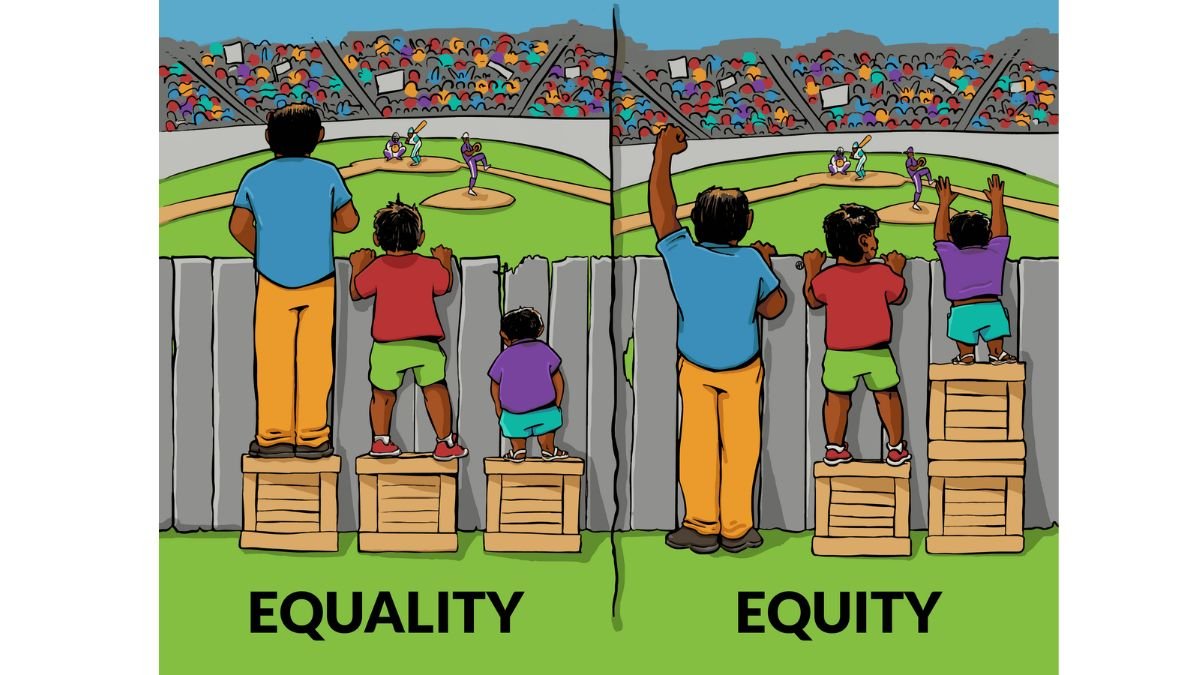
A common way to understand the difference between equality and equity is through visual metaphors. Imagine three people of different heights trying to watch a baseball game over a fence. Equality would give each person the same-sized box to stand on. The tallest person can easily see over the fence, the medium-height person can just see, but the shortest person still cannot see at all.
Equity, however, would give each person a box adjusted to their height. The tallest person may not need a box at all, the medium person receives one box, and the shortest person gets two boxes. With these adjustments, all three individuals can enjoy the game equally. This metaphor illustrates that fairness often requires treating people differently, depending on their circumstances.
Why Equity Leads to Better Outcomes
Prioritizing equity over equality produces better outcomes both for individuals and society. When people are given resources and support tailored to their needs, they are more likely to succeed, contribute meaningfully, and feel valued. Equity ensures that opportunities are accessible to everyone, regardless of their starting point, which helps reduce disparities over time.
In education, equitable approaches such as tutoring programs, scholarships, and inclusive curricula help students from marginalized backgrounds achieve outcomes similar to their peers. In healthcare, equity-focused policies that provide additional support to vulnerable populations improve overall public health and reduce disparities. In the workplace, equitable practices like mentorship, flexible work arrangements, and targeted professional development increase productivity, satisfaction, and retention.
Equity in Social Policy
Equity also plays a crucial role in public policy. Governments and organizations that adopt equity-focused approaches aim to reduce social and economic disparities. Policies such as progressive taxation, affirmative action, and targeted social programs acknowledge that not everyone starts from the same place and that additional support is necessary to achieve fairness.
For example, providing free access to quality education, healthcare, and childcare in underprivileged communities ensures that residents have the same opportunities as those in more affluent areas. Equity-oriented policies recognize the barriers created by history, geography, and socioeconomic status and work to remove them.
Challenges in Implementing Equity
While the benefits of equity are clear, implementing it is not always straightforward. Some people may perceive equity-focused measures as unfair because they involve giving more support to some individuals than others. This misunderstanding arises from equating fairness with treating everyone exactly the same, rather than understanding fairness as addressing unequal starting points.
Another challenge is measuring need accurately. Equity requires careful assessment of individual or community circumstances, which can be complex and resource-intensive. Despite these challenges, striving for equity remains essential for creating inclusive and just systems.
Moving Beyond Equality to Equity
To create truly fair and just systems, it is important to move beyond equality and focus on equity. This requires acknowledging historical and systemic inequalities, understanding individual needs, and tailoring resources and opportunities accordingly. Equity does not eliminate the value of equality; rather, it complements it by ensuring that equal treatment is meaningful and effective for all.
Educators, policymakers, and community leaders can promote equity by actively listening to marginalized voices, implementing targeted programs, and continually assessing outcomes to ensure fairness. By prioritizing equity, society can work toward reducing disparities and creating opportunities that allow everyone to thrive.
Conclusion
Equality and equity are distinct concepts that serve different purposes in the pursuit of fairness. While equality focuses on uniform treatment, equity emphasizes fairness by accounting for differences in circumstances, resources, and opportunities. Without equity, equality alone often fails to address systemic disparities and can leave marginalized groups at a disadvantage.
Understanding the difference between equality and equity is essential for education, healthcare, workplaces, and social policy. Equity ensures that everyone has what they need to succeed, regardless of their starting point, and ultimately leads to a more just and inclusive society. By moving beyond equality and embracing equity, individuals and institutions can create a world where opportunities are accessible to all, and success is determined not by background but by potential and effort.
